National Museum of Bhutan
Temples in the National Museum of Bhutan
Temple of the Tree of Merit (Tshogzhing Lhakhang)
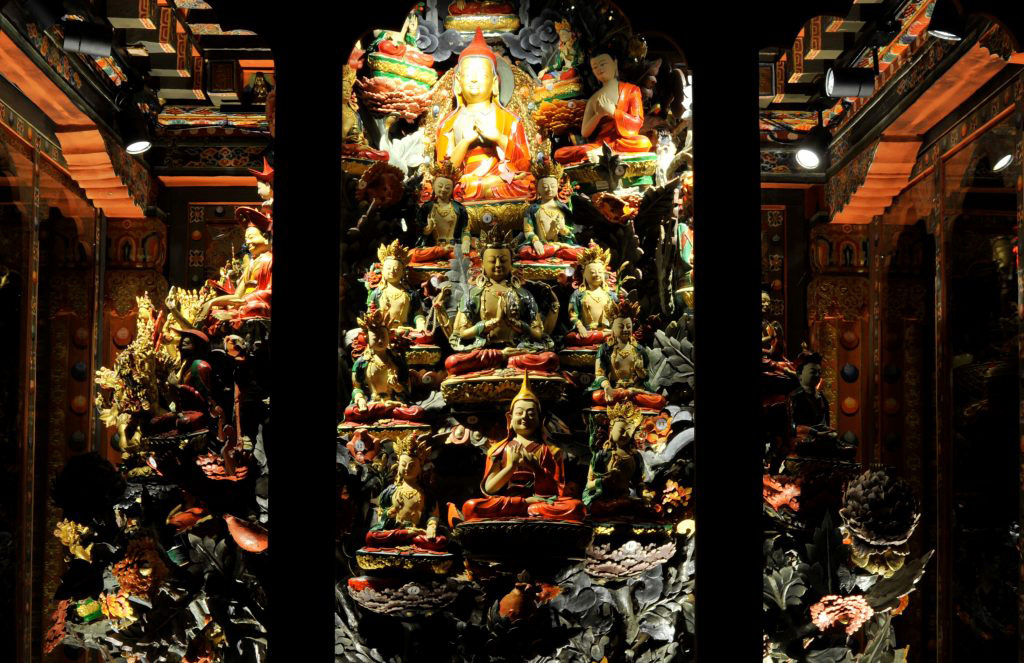
Tshogzhing Lhakhang on the sixth floor of the museum functions as a sanctuary for prayer and meditation. Monks, practitioners, and pilgrims visit this Tree of Merit to engage in quiet contemplation and offer prayers.
At its center, the three-dimensional mandala rises as a cosmic tree. In traditional belief, standing before a consecrated Tshogzhing is considered equivalent to being in the direct presence of the living assembly of all Buddhas.
Commission in 1968, under the royal patronage of the Third Druk Gyalpo Jigme Dorji Wangchuck, master clay sculptor Lopen Damcho and a team of apprentice artisans translated flat painted thangkas into a multi-tiered clay mandala with intricate, hand-sculpted clay figures. it remains one of the crowning artistic achievements of 20th-century Bhutanese craftsmanship.
Uniquely, the tree unites all four major schools of Himalayan Buddhism—Nyingma, Kagyu, Sakya, and Gelug.
Viewing Experience: Because it occupies the round gallery of the Ta Dzong, visitors circumambulate (kora) the tree in a clockwise direction, an act believed to generate merit and positive karmic energy.
Temple of God of Wealth (Namsey Phodrang)
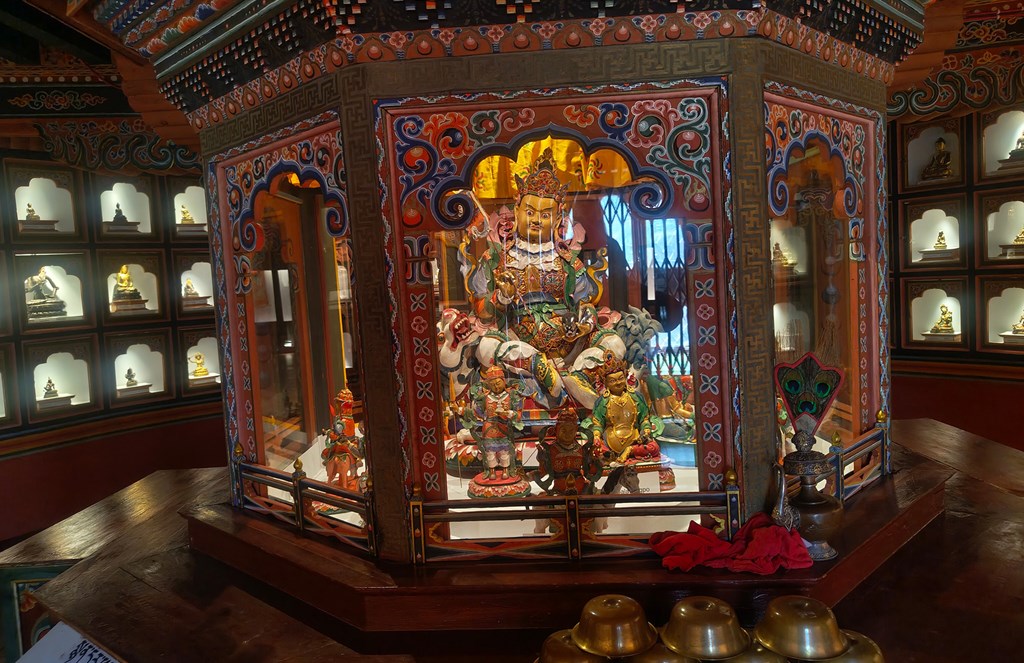
Located in the inner circular chamber on the fifth floor of the National Museum, Namsay Phodrang is a temple dedicated to Gyalpo Namthoe Sey (Skt. Kubera), a revered deity of fortune & wealth.
Namsey is depicted riding on a snow lion encircled by the Namsey Tadgyed—eight horse-mounted yakshas guarding the four cardinal and four intermediate directions. Together, they channel auspicious blessings of spiritual and material prosperity.
The God of Wealth will grant blessings of wealth in each of the four directions so visitors should make their wishes quietly at the altar in front of each wealth deity. If one’s mind is mired in greed, then the wishes may not be fulfilled.
The inner chamber also houses rare treasures: ancient statuary cast in dzikhim—a prized, luminous metal alloy—alongside a revered 10th-century Kadam-style stupa and finely etched slate carvings of the Twenty-One Taras.