News & Events
Advanced Digital Imaging Workshop Equips Heritage Conservators
Cultural conservators and museum professionals from across Bhutan have concluded an intensive, hands-on training program in cutting-edge heritage science, completing the Advanced Digital Imaging for Conservation and Collections Management Workshop led by the international Hidden in Plain Sight (HiPS) research team.
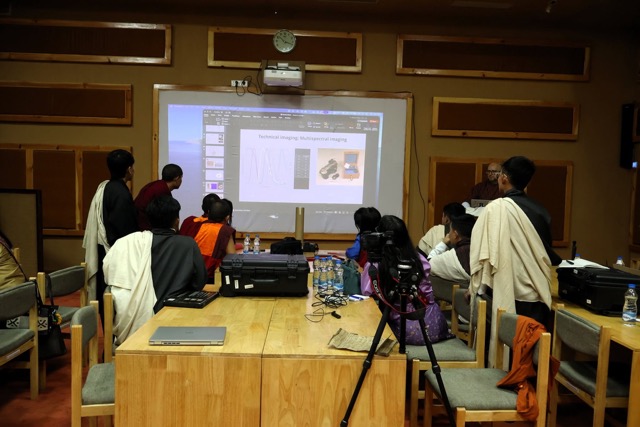
The day-and-a-half program, which culminated on September 1, 2026, was organized in partnership with the Museum Division of the Department of Culture and Dzongkha Development. The initiative was designed to transfer non-destructive, laboratory-grade imaging and material analysis techniques directly into the hands of Bhutanese institutions responsible for safeguarding the nation's cultural and monastic heritage.
Moving Theory into the Laboratory
Following introductory foundational sessions, the final day shifted focus to practical, hands-on application. Participants were divided into four rotational cohorts to work directly with specialist equipment and analytical protocols across key operational areas:
-
Collections Risk Management: Led by Dr. Ayesha Fuentes (Museum of Archaeology and Anthropology, University of Cambridge), focusing on preventative measures and mitigating environmental and physical risks to fragile holdings.
-
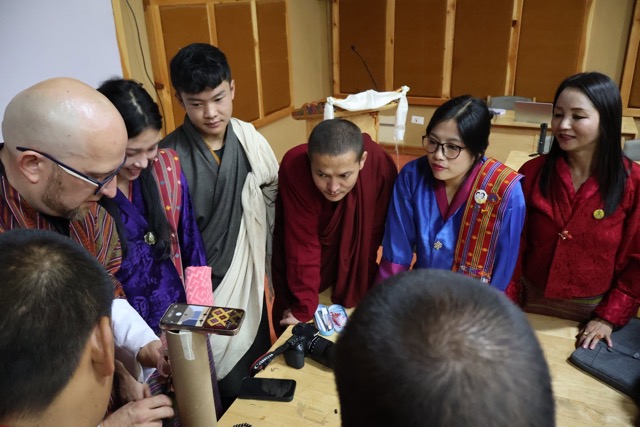
Advanced Digital Imaging, Analysis & Spectrometry: Led by Dr. David Mills, demonstrating non-invasive spectral analysis to determine material composition and detect hidden pigments without invasive sampling.
-
Photography & Specialized Documentation: Led by Maciej Pawlikowski (Cambridge University Library Digital Content Unit) and Merina Tuladhar, covering high-resolution capture, multispectral documentation standards, and precise archival cataloging.
-
Heritage Science Interpretation: Facilitated across all cohorts by project lead Professor Eyal Poleg (Queen Mary University of London), connecting scientific data with the cultural, historical, and material interpretation of sacred artifacts.
Following the rotational sessions, specialists and participants transferred to the Textile Museum laboratory in Thimphu. There, the team conducted real-time imaging and technical diagnostic assessments on historic textiles, demonstrating how non-invasive methods reveal underlying wear, dye compositions, and previous restoration interventions.
Expanding Domestic Conservation Capacity
The workshop reflects an expanding commitment by Bhutanese heritage bodies to integrate modern heritage science with traditional preservation practices. As cultural repositories and monastic institutions across the country modernize their collections management, access to scientific imaging—such as spectrometry, multispectral analysis, and digital condition mapping—provides conservators with critical baseline data needed to protect sensitive organic materials from environmental degradation and seismic vulnerability.
The collaborative initiative, supported by researchers and technical leads from Queen Mary University of London, Cambridge University Library, and the University of Cambridge, lays the groundwork for ongoing digital stewardship partnerships between international heritage science teams and Bhutan's national museums.